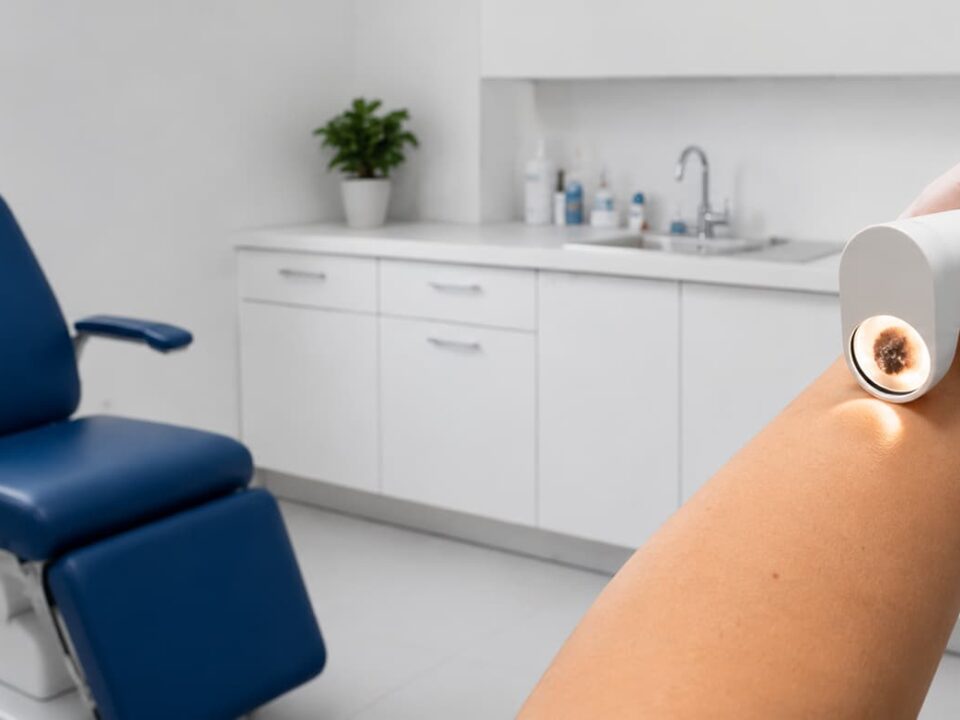
Skin biopsy

What is a skin biopsy?
Skin biopsy is a basic diagnostic test in dermatology. We are talking about the main means of confirming a clinical diagnosis and validating the opinion of the dermatologist. It also helps to distinguish what exactly the problem is in the case that the image of a skin rash can refer to many different diseases. Two main specialties collaborate in skin biopsy: the Dermatologist and the Pathologist.
How often is a skin biopsy needed?
It is an examination that we often employ to solve diagnostic problems. In Dermatology and Venereology there are hundreds of diseases and clinical syndromes! So we understand that sometimes it can be difficult for the doctor to make a diagnosis with a simple examination.
We also use skin biopsy to monitor the course of already known diseases. For example, repeated biopsies are taken at regular intervals and from different sites in cases of spongiform encephalopathy in order to determine the response to treatment.
Other times, an initial diagnostic punch biopsy can serve to determine the strategy for removing a lesion (e.g., whether to proceed with wide surgical removal, laser cauterization, diathermocoagulation or cryotherapy.)
How many types of skin biopsy are there?
There are two types of skin biopsy: punch biopsy and surgical biopsy. With a punch biopsy, a cylindrical piece of skin is taken from an area with a special tool. Both the diameter and depth of the piece can vary.
Surgical biopsy, on the other hand, is no different from a common surgical removal. It is used when it is necessary to examine the entire thickness of the skin, including the subcutaneous fat.
How is a skin biopsy performed?
Καταρχήν μιλάμε για μια επεμβατική πράξη με όλους τους κανόνες και της προφυλάξεις μιας μικρής χειρουργικής αφαίρεσης. Πριν από ολα, αναισθητοποιούμε την περιοχή προς εξέταση με τοπική έγχυση αναισθητικού (πχ ξυλοκαΐνη) ή αναισθητικής κρέμας. Καθαρίζουμε την περιοχή με αντισηπτικό για αποφυγή μόλυνσης. Στη συνέχεια εκτελούμε την αφαίρεση του κομματιού είτε χειρουργικά είτε με τη βοήθεια του ειδικού punch. Τα χείλη του τραύματος κλείνουν με συρραφή εκτός από την περίπτωση punch διαμέτρου μικρότερης των 2 mm οπότε δε χρειάζεται. Αφαιρούμε τα ράμματα μετά από λίγες ημέρες ανάλογα με την περιοχή.
Βάζουμε το τεμαχίδιο δέρματος σε ειδικό ποτηράκι και το μεταφέρουμε στο παθολογοανατομικό εργαστήριο για επεξεργασία και εξέταση. Ο συνήθης τρόπος φύλαξης του δείγματος για απλή ιστολογική εξέταση είναι σε μονιμοποιητικό διάλυμα φορμόλης. Ο Παθολογοανατόμος μετά από επεξεργασία εξετάζει το κομμάτι. Η εξέταση μπορεί να είναι μια κοινή ιστοπαθολογική έκθεση ή πιο εξειδικευμένος έλεγχος όπως άμεσος ανοσοφθορισμός ή ανοσοϊστοχημεία. Στη συνέχεια ακολουθεί η συγγραφή της έκθεσης που απαντά στα ερωτήματα του Δερματολόγου.
What should we pay attention to before and after a skin biopsy?
We usually do not ask for any special preparation. The patient does not need to fast and takes any medication as normal. It is good for the doctor to know if the patient has a general tendency to develop keloids and unsightly scars. This is of course only known if other surgeries have been performed before. Very rarely does the patient modify the anticoagulant treatment he is receiving as the procedure is minor and short.
The instructions for the post-examination are no different from those of a typical minor surgical removal. Usually the examinee avoids exposing the wound to water for one or two 24 hours. He also cleans the wound with a mild antiseptic and dries well after washing. As long as there are stitches in the area, he must definitely avoid swimming in the sea. The patient must know that healing in the examination area continues even after the surgical stitches are removed. Therefore, care with a healing cream or gel is needed until complete recovery and for an excellent aesthetic result.
Are there any side effects or complications from skin biopsy?
A skin biopsy is a safe and quick procedure. The only problems encountered are the same as those that occur with any minor surgical removal. That is, microbial contamination, broken sutures, or poor healing. The chances of these occurring are minimal if the patient follows the doctor's instructions correctly.